Tuesday, October 24, 2006

OOW2K6: Manic Monday Pt 2

I had a slight schedule clash yesterday afternoon. Steven Feuerstein's 10 Things NEVER to do in PL/SQL started at the precise time that Tom Kyte's Database Worst Practices ended but they were in buildings a brisk ten minutes apart. So I decided to attend Steven's talk. I'll be hearing Tom speak at the UKOUG Conference but Open World is my only opportunuity to hear Steven. This was a good call.

I'm tempted to gloss his talk as Chicken Soup for the PL/SQL Programmer's Soul, because it was full of sound advice: drink lots of water, take regular exercise, play mind-developing game with your kids. He didn't quite say "eat up your greens" but it was definitely implied. This is, of course, sensible advice. The rest of his equally sensible points were on best practice in software development in general, although obviously focused on PL/SQL. Ask for help. Don't trust a guru just because they've written a book: verify everything. Share code and ideas.

I liked this talk a lot precisely because it dwelt on process. The tendency for conferences is to focus on features and functionality, which is useful but such information is usually obtainable if you know how to use the documentation and Google. So it's a nice change to hear somebody talk about ways we can make ourselves better programmers and do our jobs more effectively. People do take exception to some things Steven has written. But over the course of ten books it is inevitable that he has said stuff that is incorrect, dumb or just doesn't jive with our world outlook. But at least he admits it when he's been wrong. I think if we all applied the practices in his books rigourously in our coding we would universally be writing better code than we are right now. Of course, never take a guru's word for anything ;)

I think Steven will have trouble launching his new acronym on the world. He was talking about having a Single Point Of Definition for everything - formulas, business rules, SQL. This is like the Pragmatic Programmers' Don't Repeat Yourself rule. The thing is, spod is already a word, at least in England, and it's not complimentary. So the statement "I'm going to SPODify my code" is likely to be met with the rejoinder "Don't you think it's spoddy enough already? Why not try improving it instead?"

Hanging with Eddie


I met Eddie Awad in the Feuerstein talk and we did a tour of the Moscone South exhibition hall. The big hit of the open hour was the EDS stand. They were giving away these cool-looking blue lagoons (a cocktail, m'lud) with a flashing "ice cube" in them. Major queue for those. Another stand had a guy riding a Segway to drum up trade for a presentation about their product. Eddie managed to blag a ride on the thing in return for watching the presentation. I always thought that people on Segways look a bit dorky but Eddie managed to make it look cool. Before boarding the vehicle Eddie handed me his camcorder, which is why the video on his site is not up to his usual standard.

OTN Night at the Oasis


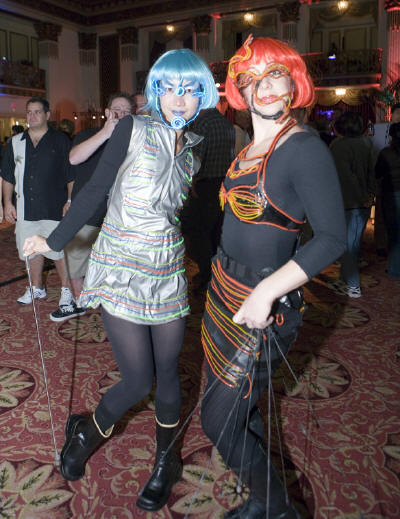
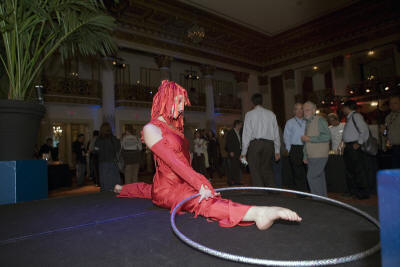
This was a bit of an odd one. Every conference seems to do it: put a group of overwhelmingly male software geeks of an unathletic disposition into a big room and play really loud dance music at them. This year OTN had hired some lithe female dancers in bizarre costumes to really point up the contrast. In one of the other rooms there were some low stages with exotic dancers of various persuasions - contortion artiste, snake dancer, belly dancer. It wasn't actually a burlesque show but I found it a bit disturbing. Oh, and the bars closed an hour before the event was due to end. On the plus side I got to talk with my Dutch colleague Roel Hartmann, Oracle's Sue Harper and some people from the UKOUG.

Monday, October 23, 2006

OOW2K6: The madness begins

It's only Monday and the Moscone Center is already showing some strain. At one point I was stuck trying to get from the Exhibition Hall to Room 104, a distance of about thirty yards. But the only path was through a chicane formed by the queue for coffee going west and the queue for email access going east, with a stream of other people travelling the opposite way. I/O bottlenecks, we got 'em!

The policy of closing the exhibition halls during the keynotes is already getting annoying. There are thousands of people who physically can't get into Hall D and they need something to do. Shutting the exhibition halls just creates crowds of lost-looking people with nowhere to sit.

My choice of sessions yesterday seems to have been remarkably prescient. Chuck Rowzat's keynote devoted a lot of time to the new BI Suite functionality which Mark talked about. Perhaps Oracle really did buy Siebel just to get its BI Analytics software. And Andrew Mendelsohn's talk on the Future of database technology revealed that 11g will automate the partition and compress strategy that Tim Gorman presented.

The other stuff in 11g is geared towards managing change, so maybe we should steel ourselves for a suffix change: 11c anyone? Some of this is going to be a hard sell because Oracle are not backporting these features . "If you upgrade to 11g it be easier for you to upgrade when 12g comes out!" is not a compelling marketing message. But I suppose the hot patching functionality does build on the automatic database management stuff which distinguished 10g. Interesting show of hands: a large majority of people in this session were still using 9i.

Then it was showtime. Apparently my session was sold out, although in the end it wasn't quite full - perhaps some people found the prospect of lunch more appealing - and everybody who wanted to got in. Mostly it went alright (I think). The one problem I had was using SQL*Developer to run the test script but TextPad to edit the code. My laptop frequently froze during the context switching so I was only able to run about half of the demo. I'm not sure why that happened: I had been careful to disable my virus scanner before I started the session. Maybe it was something to do with running through the big screen. Still it gave me the opportunity to get some cheap laughs at the expense of java.

At least now I can relax and enjoy the rest of the conference. If I can somewhere to sit, that is.

OOW2K6: Sleepy Sunday

The first presentation of Open World for me was Tim Gorman's talk on Scaling to Infinity. Obviously I didn't read the abstract properly because this took me by surprise. Instead of being a way to gently ease myself into the spectacle Tim's talk gave me some very useful insights that are immediately relevant to my current project. "All databases are victims of their own success" was especially resonant. Tim's key point was that we can only scale VLDWs if we design them properly from the startpoint. In particular we need to avoid any heavyweight DML (i.e. UPDATE and DELETE) and use partioning smartly. One of my pending tasks is to improve the elasped times of queries in the searching datamart. I think in the light of Tim's talk I am going to have to revisit my implementation (which uses bitmap indexes and partioning) as I'm not sure it's going to scale to infinity.

After that it was up to the icy wastes of the Hilton's sixth floor to watch "Tiger" Mark Rittman dicing with death. Or at least exploring the slapstick possibilities offered by the trailing radio mike's cables. Beforehand Mark had expressed a concern that he wouldn't be able to fill the ninety minute slot on the new BI Suite EE. But in the end he ran out of time, with material still to do. Who would have thought Mark could be so talkative? I had better quickly say that Mark's presentation was coherent and informative and didn't feel incomplete. And he coped gracefully with the inevitable failure of one of his demos.

In the evening the ACEs dinner was nice, although I drank too much wine and didn't eat enough food. I almost got stuck with the bill after the manager mistook me for Andrew Carr. Well, I thought she said "Are you Andrew Clarke?". It doesn't help that we are both balding, bearded and British. Fortunately I eventually managed to introduce her to the right Brit, otherwise I'd be there still, washing dishes. I ended up seated next to Steven Feuerstein who wanted to know whether my presentation was going to focus on utPlsql (which it does). He thinks Code Tester (formerly QUTE) is a much better tool and he's certainly convinced me to take a second look.

I was awake again at 02.00am so I went through my presentation once more. Just as well: I ran my scripts and the first test failed with ORA-01438: Value larger than specified precision allows for this column.  I know I've joked about breaking my demo but this wasn't funny. Eventually I figured it out. The EMP.EMPNO column is NUMBER(4,0) and I had simply run the code so often that my EMPNO_SEQ had clocked 10000. After I dropped and recreated the sequence the scripts ran fine.

Sunday, October 22, 2006

OOW2K6: Weather update

The Oracle slogan for this year is Better Information, Better Innovation. Here is an instance of innovation. The conference bags contain a Fujitsu-Siemens branded umbrella, which makes a change from the usual mouse mats and stress balls. Unfortunately the current weather situation demands sunscreen instead. Did I just say "unfortunately"? Tee hee!

I'm writing this after the speakers' meeting, which included some facts about the conference. Apparently there are over forty thousand registered attendees but on the peak night there will be delegates staying in just fourteen thousand hotel rooms. So either Kent Graziano isn't the only person looking to crash on somebody's floor or else the conference is going to be livelier than we might have imagined.

OOW2K6: ACEs high

Well here we are again. I've already guided one lost resident of Phoenix to the Moscone Centre (or Center, I suppose). She asked me if I was from round these parts. I guess SF is so unlike the rest of the US they just expect its residents to speak with English accents.

Anyway, I met up with Mark Rittman and Tim Hall in the King George yesterday. All of us had been on the go since the crack of dawn BST but we agreed the best thing would be to stay awake until bedtime PST. So we did a mini-pub crawl: an "Irish" pub round the corner from the hotel and then down to scope out the Thirsty Bear. Mark was happy with it as the location for the Bloggers' lashmeet-up on Tuesday. This was the first time I had met Tim in the flesh. I think it went okay although at one point I found myself ranting on and on about Warrior. Why? I haven't read a graphic novel in twenty years! I think I got away with it.

We managed to still awake until 10.00pm PST. The beer undoubtedly helped. Unfortunately I still woke up at 2.00 in the morning (the beer again). So I ended up running through my presentation and polishing the demo. I hope I didn't break any of my code. That would be so ironic.

Thursday, October 12, 2006

OOW2K6 Keynotes

Oracle has published the schedule of keynote speakers for Open World.  To be frank for me  keynotes are usually the least appealing component of most conferences.  Keynote speakers tend not to to leaven their marketing spiels with humour or insight.  Which is fair enough, they're executives not court jesters, but it can make for some turgid speeches. 

Still, one of  the advantages of attending Open World is the opportunity to see most of the big beasts of the IT savanna.  With the (understandable) exception of Microsoft and IBM the main players in chips, boxes and wires are all present. This means that the speeches are more interesting because there's more needle. Obviously everybody bashes Microsoft and IBM.

The ones that look the most interesting are:>

Tuesday, October 24 8:30 a.m.-9:15 a.m. PT

Mark Hurd, Chairman and Chief Executive Officer, HP is talking a little early in the morning after OTN Night.  But it will be worthwhile turning up for just the last ten minutes to see whether he takes questions on employee surveillence.

Wednesday, October 25 10:00 a.m.-10:45 a.m. PT

Jonathan Schwartz, Chief Executive Officer and President, Sun Microsystems, Inc.  has the hardest task of the week.  Scott McNealy was easily the most entertaining keynote speaker I saw at previous Open Worlds.  Is Schwartz going to try to match his predecessor's charm or will he play Iron Chancellor Brown to McNealy's Blair?

Wednesday, October 25 1:00 p.m.-2:00 p.m. PT

Larry Ellison, Oracle Chief Executive Officer will almost certainly be impossible to see live.  If you don't know somebody with influence who can reserve you a seat and you don't want to blow a roadie to get a backstage pass your only option is to start queueing before lunchtime.  Probably best to watch it on TV from the comfort of a bean bag somewhere in the Moscone Centre. 


powered by performancing firefox

Monday, October 09, 2006

OOW2K6: The buzzstorm gathers

So less than a fortnight to go until Open World and as Eddie Awad has pointed out, the Oracle blogosphere is picking up on it.  OOW2K5 was the time when I really got into blogging.  One of the things Oracle get right is providing large villages of PCs, locked down to do nothing more than run a browser.  (what a keen idea! maybe Oracle should market this concept.  They could call it, I don't know, a network computer...).  So it's easy to get access to the internet at points around Moscone centre without lugging a laptop around.

Connecting with your peers

Oracle have introduced an interesting innovation this year: Connect.  This is just a gussied up forum site but with a social spin.  The point is to find other OOW attendees with similar interests.  So there are forums with threads and posts, as you would expect, but there are also channels for communicating privately with other attendees and arranging meetings.   There's a function to "Request Introduction" - which seems  like Jane Austen gone high tech - and another one to "Request Meeting", which is obviously a bit forward if you haven't been introduced.  The obvious intention is to arrange business networking opportunities, power breakfasts and other high concept stuff.  In practice I think it will mainly just groups of developers and DBAs arranging to discuss IDEs and ASSM over beers.  

The forums are groups set up by individuals.  Most of the current ones represent some aspect of the Oracle community.  There are ones for various user groups and Laurent Schneider has set up a couple that intersect with my interests: Oracle bloggers and OTN Forums regulars.  I have set up one myself, the Jetlagged Junta, although to be honest I've really not got any idea what I'm going to do with it.  At the moment the only group that is seeing much action is the OOW Newbies group, which is helping neophytes plan their conference.  Once Open World starts I think Connect could be a useful way for us to hook up with people who we only know by email address or forum handle.  And with forty-one thousand attendees we are going to need all the aids we can get.  

So I urge attendees to sign up for a Connect group.  If there isn't one to suit your interests create one.  Note that you have to tick a box on the registration form to enable your access.  If you didn't do this when you registered you will need to re-click through your registration form (I think the relevant checkbox is at the bottom of the third page). 

Airport security


I have almost finished my paper on PL/SQL and automated unit testing.  But I am finding it quite hard to get it all down in a way that is going to make sense to anybody.  I keep switching between explaining the philosophy of automated unit testing and explaining utplsql.  Still I'll get it done somehow.  At least I have the actual presentation under control: that has the potential to be far more embarrassing because it's so much more public and I'm doing a demo this time.  I was toying with trying to use VMWare
for that but having seen a VMWare demo go ka-blooie at the recent DE SIG I think I'll stick with an actual environment.  At least I know what I already have works and there's enough on my plate with the day job. 

What this does mean is that I have to sort out my carry-on luggage.  As I'm doing a demo as part of my presentation I will be bringing my laptop to the US.  In previous years I haven't bothered.  I hope I can take my laptop on board with me instead of having to check it in to the tender mercies of the baggage handlers.  Are we allowed liquids yet?  

I notice that the agreement between Europe and US Homeland Security about the sort of information that it will divulge about airline passengers has run out.  Apparently they didn't tell the US about passengers who have ordered kosher or halal meals, because that reveals their religion and so infringes their privacy.  But they did pass over the names of people who have ordered vegetarian meals.  Ignoring the fact that many people will order the veggie option because of their religion (Brahmins, Jains, Buddhists) just what did the US authorities do with this information?  Were they concerned that a cadre of militant vegetarians might stuff themselves with bean burgers over the Atlantic with a view to launching a poisonous gas attack in a confined area?  Or is it simply that anybody who doesn't eat beefburgers and fried chicken is inherently unAmerican and therefore worthy of suspicion?  


powered by performancing firefox

Wednesday, September 27, 2006

Useful article on regex in Oracle 10g

cd has written an introductory article on regular expressions in the 10g database. As he doesn't have a blog (imagine!) he has posted it in the OTN PL/SQL forum. In this first article cd shows how we can use Oracle's regular expressions to determine whether a string contains a valid number.

For those who don't know, regular expressions are a way of searching text for patterns rather than literal matchings. It's a cool way of manipulating large amounts of text, including .CSV files and programs. I'll just mention a little utility I have found very useful: the Regex Coach. This nifty piece of freeware (written in Lisp!) provides us with a sandbox in which we can test regular expressions against a target piece of text to see what they will find. It handles replace too. Very useful if you are just starting to find your way around regex. Check it out.

Regex is a topic big enough for a whole book. The book I have found useful is the Mastering Regular Expressions) by Jeffrey E.F. Friedl and published by O'Reilly. Even though reading it does make me think I ought to know more about perl than I actually do.

Update


cd has subsequently published two further articles about Regular Expressions in the OTN forums:
Part Two deals with testing Regular Expressions.
Part Three looks at complex formats such as IP addresses and discusses the 10gR2 enhancements.

Wednesday, September 20, 2006

UKOUG Dev. Eng. SIG 19-SEP-2006

When I introduced the agenda yesterday morning I said I thought it was quite forward-looking, all about new stuff - new features, new tools, new architectures. It turns out it was really all about rebadging of old stuff and integration of existing applications. Very much a case of "back to the future". Hmmm. Still at least the SIG kicked off with something innovative. Julius Kisielius (UKOUG) ran a session of Speed Networking. This is a bit like Speed Dating, only without the exchange of bodily fluids. This worked quite well as an icebreaker and the buzz it generated lasted well beyond coffee time.

Ben Wooton (Oracle) presented on migrating workgroup databases to ApEx and XE. Workgroup databases is code for "Excel and Access". Ben fought hard to stop dissing Access all the time, but his key point is valid. Anybody who has done consultancy has been to places where the IT Dept has too process and not enough delivery and users have filled the gap with ad hoc lightweight databases. These breed like rabbits and frequently become essential to the business, without having any proper oversight, especially of data integrity and security. I was quite concerned but not surprised to hear Ben say that one of the sites where he had taken his crusade against such practices was a police force. Ben's talk gave a useful overview of the considerations for migrating from such jury-rigged environments to a consistent and coherent ApEx one.

Next up was David Rowe (Rocela) talking about Oracle Customer Data Hub. I vaguely knew that CDH came out of Applications but I hadn't realised it basically was E-Business Suite. Seriously, the first step in implementing Customer Data Hub is installing EBS. Ouch. I found this talk stimulating and useful. It was an architectural rather than heavily technical. The main point about data hubs is consolidating the data in all your systems so that you have a single view of Customer (or whatever type of party your business is interested in). This is not a one-off exercise but a continuous process of sharing, synchronisation and correction. As you might have guessed, the biggest issues here are not technical but procedural and cultural. It certainly showed me how far my current project still has to go before it even approaches being a proper data hub.

Forms: back like it never went away


After lunch Grant Ronald(Oracle) presented the headline new features for the next release of Forms (currently just version 11, marketing suffix yet to be decided). Many people I talked to during the speed networking session had come primarily to hear this talk. The focus of the next version is on administration, deployment and integration with other applications. Although there were a number of new features there wasn't much to set the pulse racing - useless diagnostic logging and tracing makes you hot. The only thing that I would have found useful in the days when I was a Forms developer is the ability to respond to external events. Several projects I worked on would have benefited from that.

So whilst I accept Grant's assertion that Forms is still a living and supported tool, I think the days when a new release of Forms was a major event have long gone. As a SIG chair this is disheartening because it means that the main theme for Forms presentations remains migrating from client/server to the web. So I'm thinking about running a SIG with a retro programming theme - client/server and character-based Forms, RPT, user exits and Pro*C. [1]

The final presentation of the day was supposed to be Susan Duncan (Oracle) talking about the development roadmap to Fusion. Unfortunately her VMWare demo blew up and sent her laptop into meltdown. I'm going to ask Susan to have another crack at doing her presentation next year, if yesterday's experience hasn't left her too traumatised. Anyway, Grant vamped gallantly for forty-five minutes on the future of Forms and E-Business Suite. Although EBS version 12 is scheduled to be on the "Fusion Stack" (basically the JDeveloper J2EE framework) it will still contain screens written in Forms, due to pressure of time. One interesting aspect of this process is that Oracle won't be producing tools like the FMA. EBS are not migrating their Forms screens to ADF and JSF, they are rewriting them. This is because the Fusion version of EBS has to incorporate elements of PeopleSoft, JD Edwards, Seibel and anything else Larry takes a fancy to, so straight migration is not a viable option. Grant rounded off with a quick showing of the new pre-beta rich client (JSF and AJAX) and a simple how to do Forms-type stuff in JDeveloper.

Summing up


Overall this is an interesting time to be in Oracle development. For a while back it seemed as though Oracle were turning their back on their Tools customers, what with the de-supporting of Forms client/server mode and the slow throttling of Designer. But during the last twelve months there has been a flurry of activity. JDeveloper continues to grow relentlessly. It will eventually be a sophisticated suite of tools aimed at a number of different user roles. The JDev team have learnt from Eclipse and have rebuilt JDeveloper as a plug-in framework,so different users can customise the IDE to their own needs. There's still some way to go in reducing the complexity of it; I frequently lose panels when I'm working in the IDE (although I'm getting better at finding them again). SQL Developer and ApEx are two new initiatives, although they are actually existing functionality productized and then marketed. Ben Wooton said a couple of times that he though ApEx is positioned wrongly as a replacement for workgroup databases, because it is actually more powerful than that. In the future the marketing of ApEx may change: there is currently not so much a steep learning curve as an actual discontinuity between building a simple application in ApEx and building an enterprise system using JSF and ADF. Oracle needs a development tool to bridge that gap. Funnily enough it ought to be Forms. We shall see.

In the meantime it seems certain that Oracle has final woken up to something Microsoft has known for a long time: the value of mindshare. Get developers building applications with your products and you can monetise things later. So Oracle have decided to love developers again. We can see this not just in the tools space itself but in the Oracle Develop initiative at Open World. Now if they could just bring themselves to address the question of modelling everybody would be happy...

Finally my heartfelt gratitude goes to all the presenters, to Julius at UKOUG for his galvanising e-mails and to everybody who attended. Tomorrow I can start worrying about the next SIG.


[1] At the moment I'm only joking but if people are genuinely interested in such an event then who knows?

Friday, September 15, 2006

Clarke's Three Laws of Office Life

First law: For every situation there is an equal and apposite Dilbert cartoon.

Second Law: The number of meetings required for any process is proportional to the quality of the biscuits provided at meetings.

Third Law: The bloke with the most annoying laugh is the one who finds everything funny.

Many office laws - The paper tray is always empty when you need a hard-copy right now - are just special cases of the more general Sod's Law. Whereas these are, I think, genuinely fresh insights. However, I'm not claiming originality. The First Law of Online Life is that somebody has always thought of it before you did.

Monday, September 11, 2006

At last the agenda for the DE SIG

or "Sisyphus Revisited"


or "Where Have All The Oracle Developers Gone?"


Finally the full agenda for the Development Engineering SIG is published on the UKOUG web site. It's quite close to the wire ( the meeting is 19th September) but at least we made it. At one point I thought I was going to have to postpone the SIG until after the Conference because it looked like I couldn't get enough speakers. When I started n July the process of assembling the agenda I had the promise of presentations from three people who had not been able to make the previous SIG. Alas none of them could make September either. So instead of having to find just two speakers I suddenly had an empty agenda to fill, over the summer holiday season. That we do have a full agenda is really down to great support from our Oracle Buddies, Grant Ronald and Stephen Wallace, and sterling organisation by Julius Kisielius in the UKOUG office.

In the end I think it is quite a good line up:

  • APEX - Ben Wooton, Oracle
  • Oracle Data Hub Offerings - David Rowe, Rocela
  • What’s new in Developer Forms 11g - Grant Ronald, Oracle
  • The future of Application Development in Fusion - Susan Duncan , Oracle


So lots for developers - something on Forms, something on Fusion, something on TAFKAH - and something for systems architects too.

There are three obvious points about this agenda.

One is the omissions. Nothing on JDeveloper, nothing on SQL Developer, nothing on esoteric topics like PHP or .Net. Well, we cannot cover everything in every meeting and the DE SIG has a very broad waterfront to cover. Also, I have to work with what I can get. The Lord knows I have tried to get a PHP on Oracle presentation. I have struck out with three different sources. Maybe next year it will happen.

Secondly, there are two talks about Forms (the talk on Fusion will outline how Oracle is moving its applications from Forms to the Fusion tool set, which is Java-based). I was forwarded an e-mail recently from someone observing of the presentation on Forms 11g, "what is there left to say about Forms?" Now Grant will disagree but I have a certain sympathy with this viewpoint: Forms has been around for a long time and once you've got over the hurdle of migrating from client/server to web there really wasn't much new stuff in Forms 10g. However, a large chunk of the UKOUG development community are using Forms and I owe it to them to include talks on the tool set. As long as Oracle is supporting and indeed extending Forms there is news for the SIG to convey. Anyway, I asked this person what topics they would like to see in a DE SIG agenda. Naturally I am still awaiting a response.

Lastly, the speakers. Three are from Oracle and the fourth is from Rocela, a consultancy founded by ex-Oracle employees (indeed I think David is ex-Oracle himself). Again this is question of working with what I get given. At every SIG I stand on my hind legs and solicit presentations from the audience but the actual presenters are almost always from Oracle itself, other consultancies and vendors. These are three classes of people for whom presenting is a core skill. If you work in sales, pre-sales or consultancy you have to be able to explain technical subjects to a variety of audiences in a fluent manner. Obviously I am profoundly grateful for the support the SIG receives from the chaps and chapeses in Oracle but it would be nice to hear from some more "real people".

Call for papers


I guess many in the DE audience don't feel the compulsion to present or are too shy to talk in public or just don't think they have anything to talk about. Over the years we have tried to introduce a couple of different formats to encourage new speakers - short slots talking about a particular little utility or tool which we've found useful, war stories about when some project went horribly wrong - but these haven't taken off. Which is a shame, because giving a presentation can be rewarding in its own right - just ask Bob Baillie. So if anybody reading this (in the geographical environs of the UK) does feel inspired to give a talk please contact Julius at the UKOUG office (or leave a comment here). And don't worry if you have not spoken in public before, we will provide support. Indeed the UKOUG offers free course in presentation skills to its members (although you don't have to be a member to present at a SIG).

Developer SIGs vs DBA SIGs


The lack of "civilian" presenters does give me concern because it is a symptom of a larger problem, namely the relative small audience we get at the SIG. Normally we get between the mid-teens (Birmingham) and the low thirty-somethings (London). These attendance figures have been fairly stable for years now and seem to bear little relation to the agenda's content. By comparison the DBMS SIGs regularly get audiences in three figures. On the face of it this is ought to be surprising. After all, there are a lot more developers than there are DBAs. We could take 'em easy in a straight fight. So why are the DBA-oriented SIGs so much stronger?

Well, for starters their target audience is easy to define and relatively homogenous in its interests. If you look at the agenda for the newly-founded Oracle on Windows SIG you see the topics you would expect - availability, performance tuning, monitoring. DBA stuff is DBA stuff, only the peculiarities of the OS change. There is a large corps of excellent non-Oracle speakers, many of them "names" in the community.

The Development Engineering (Tools) SIG is different. The need for brackets says it all. Our audience is diffuse, our remit broad, our focus fuzzy. The community is diffuse, split between many different programming tools and job descriptions. It is hard to put together an agenda that will appeal to enough people that they will take a day out of their working schedule to attend. A VB.Net code monkey is unlikely to be interested in an agenda of mainly Oracle Forms presentations with a single talk on ADO. This is exacerbated by the trend towards platform agnosticism: J2EE developers tend to regard databases with distaste: they are closed, proprietary, difficult, non-extensible, nasty things. The whole point of frameworks like Spring and Hibernate is to shield Java developers from the database, so why would they want to attend, let alone speak at, a meeting dedicated to the Oracle database?

(Lack of) Conclusion


How I solve this conundrum is a different matter. It's been acknowledged for years that the UKOUG is failing to reach the developer community, and this failure extends beyond just the DE SIG: papers in the Development stream for this year's Conference constituted a scant 4% of the total submissions. Perhaps the problem is that there is no "Oracle developer community", just lots of people who develop stuff that happens to run against Oracle databases.

Anyway, for the moment at least I can relax. I have a SIG meeting with a full agenda to chair. But I know the satisfaction of organising a successful SIG will last until approximately 20th September. Then it will be replaced by the sinking realisation that it has to be done all over again.

My OOW2K6SF agenda

I've been really impressed with the schedule for Open World this year. I know some people regard the conference as a marketing exercise on Oracle's part. And indeed it is. But it's so much more than that. It's chock full of interesting presentations. In particular Oracle have really made an effort to provide talks of interest to the developer community. So I think the presentations on offer more than justify all the keynotes. And anyway Collaborate didn't offer free tickets to the ACEs.

A couple of other people have posted their schedules, so here is mine. It is my blog and it is all about me.


Sunday, 22 October 2006


2:00 PM - "Scaling to Infinity: Partitioning Data Warehouses in Oracle"

Frankly I can't think of a better cure for jetlag than listening to Tim Gorman talk about database partitioning ...

3:30 PM - "Inside Oracle Business Intelligence Analytics Server"

... unless it's listening to an equally jetlagged Mark Rittman talk on some BI technology about which I know nothing whatsoever.

In the evening it's the Editor's Choice and ACEs dinner. I get two invites for this but I won't be claiming two dinners.

Monday, 23 October 2006


11:00 AM - "The Future of Database Technology, from Oracle Development"

If Mark is correct this will be something to do with 11g beta. Rather annoyingly it clashes with Bryn Llewellyn's talk on enhancements to PL/SQL in 11g. I guess this is a deliberate piece of scheduling but still rather annoying.

12:30 PM - "Developing PL/SQL Programs, Using Automated Unit Testing"

I suppose I really ought to turn up for this one.

3:15 PM - "Database Worst Practices"

Tom Kyte should give everybody a checklist on entry so we can tick off our sins as he enumerates them.

4:15 PM - "10 Things You Should NEVER Do in PL/SQL"

And that goes for Steven Feuerstein too. I expect I'll have to attend the OTN Night wearing a hair shirt and dragging round a large candle.

Tuesday, 24 October 2006


10:45 AM - "Using Oracle Advanced Queues to Facilitate Near-Real-Time Integration"

By the time I get to SF I will already have had a crack at this task but I'm hoping to pick up a few tips from Robert Corfman which I can bring back.

1:15 PM - "Bringing Open Source Software Development Practices and Principles Into Your Company"

Brian Behlendorf was one of the founders of Apache, so he should know what he's talking about here.

2:30 PM - "Developing Solutions to Real-World Problems with Oracle Content Database"

I'm all in favour of tackling real-world problems. I hope somebody from Metalink attends to discover how to properly tag documents with metadata to help searching ;)

In the evening it's the Bloggers' dinner. Once again Mark Rittman is organising this and he's settled on the Thirsty Bear Brewing Co, which is a block down from the Moscone Centre.

Wednesday, 25 October 2006


11:30 AM - "Oracle Forensics: Collecting Evidence After an Attack"

Another annoying schedule clash, as this is on at the same time as Vipin Samar's talk on securing our assets. In the end I have opted to find out how to discover whether anybody has hacked into my system rather than trying to keep the intruders out in the first place. Perhaps this is a bad call.

2:30 PM - "Data Design Reviews: Using Extreme Humiliation to Ensure Quality Data Models"

Kent Graziano wins my vote for the best presentation title of the conference. Fortunately Kent has the chops to produce insights to go with the smartarse titles.

4:00 PM - "Dynamic SQL in a Dynamic World"

As an old skool programmer I tend to distrust dynamic programming in anything except unusual circumstances: too unreliable, too slow, too risky. So I'm looking forward to hearing a different point of view from Dulcian's Michael Rosenblum.

Thursday, 26 October 2006


9:30 AM - "Don't Let It Happen to You: Encrypt Sensitive Information in Your Oracle Database"
More on security. An area I went to learn much more about.

10:30 AM - "Meet The Experts Panel w/ Tom Kyte"

I'm joining the inestimable Mr Kyte on the OTN sofa. Possibly an enormous act of hubris on my part.

11:00 AM - ""Best Practices for Upgrading to Oracle Database 10g Release 2"

Hoping for a few tips as this is an upcoming task which I'm facing at the end of this year.

And after that I'll be leaving on a jet plane.


As I have observed previously last year's attendance made OOW2K5 quite intense at times. This year I think the additional twelve thousand attendees will turn the Moscone Centre into a veritable pressure cooker. So at some point I shall slope off for an hour to check out SFMOMA. This is slapbang next to the Moscone Centre and is an ideal place to consider issues of process and design from a different perspective.

Thursday, August 24, 2006

Quest launches Toad Data modeler

Quest have added Toad Data Modeler to their product set. They've given it the rather boring acronym TDM (try saying it aloud). As far as I can tell it is a separate product to TOAD rather than a module with the existing IDE. The licensing costs strike me as a little steep but I guess it's still only half the price of bog standard TOAD for Oracle itself. Under the hood it is CASE Studio, which Quest bought a while back.

Anyway, it supports both Entity Relationship Diagrams and Data Flow Diagrams. Which is actually jolly exciting: I can't remember the last time I drew a DFD but it was probably in 1999, the last time I worked under SSADM. As a possible replacement for Oracle Designer I think the biggest drawback is that it doesn't separate the logical and physical models: they're just two views we can toggle between. I don't know how many people actually maintain two separate models these days, but I would guess that the sort of people who care about data modeling are likely to be the sort of people who would want to keep the logical and physical models separate. And the rest of us will continue using Schemester or some other freeware. (There is going to be a freeware verson of TDM but it won't have all the features enabled; most notably it will lack reverse engineering).

Interpretation: TOAD stays one hop ahead of SQL Developer. Or two if you're one of those people hung up on the performance of your tools.

Update


I suppose I ought to make it clear that I haven't actually used TDM. I have had bad experiences when using a crippleware version of TOAD IDE. But maybe I will download the evaluation copy and see whether it cuts the mustard or cuts the cheese.

Tuesday, July 25, 2006

Niagara vs Intel: Round #1

Sun have just published a benchmark comparing the performance Oracle 10g on one of their CoolThreads servers against a four-way Xeon server running Linux. The benchmark is the iGEN-OLTP benchmark. This is significant: when I attended a Sun presentation on the new Niagara chips earlier this year CoolThreads was positioned for calculation intensive applications, web servers, etc. rather than data intensive applications.

The headline result?

When running the Oracle database 10g, the Sun Fire T2000 CoolThreads server outperformed an equivalent 4-
way Dell PowerEdge server equipped with the latest 64 bit Intel Xeon processors by over 3.5x, while
consuming 1.6x less power and occupying 50% of the data center space. It was able to do this while achieving
a 3x better price / performance ratio.


One interesting difference is that the PowerEdge install was Standard Edition (four CPUs) but the Sunfire had to have the Enterprise Edition, because the Niagara chip counts as eight CPUs. Of course, through the magic of Oracle licencing policy for Niagra chips we only pay two per processor licences. This means the price differential between running SE on PowerEdge and EE on SunFire is marginal ($65,000 and $80,000 respectively). Of course, if the application needed to use Enterprise Edition functionality the price of the PowerEdge installation would increase dramatically. As it is, the cost of the hardware represents only a quarter of the total cost in both cases.

So, an intriguing benchmark. If only because it offers sites one way to move up from Standard Edition to Enterprise Edition on the cheap.

Tuesday, July 18, 2006

India enforces a Blogspot blackout

The Indian government is blocking access to blog sites, apparently because terrorists use blogs to communicate. As somebody commented on Boing Boing,

Not only is this useless (because the terrorists can simply use proxies), it's akin to shutting off the country's telephone service because terrorists talk to each other through phones.


In the short term the blog-out is just incovenient for people. I helped one OTN forum user this morning by reproducing an entry from Scott Spendolini's blog (crucial to the success of their project apparently). But we cannot do this for everybody. The Boing Boing article includes a site with some workarounds. Unfortunately (like this blog) it's on Blogspot and so is useless to anybody whose ISP has already blocked their access.

In the long run, we can all agree the Mumbai bomb was horrific. Of course governments need to take measures to apprehend terrorists and prevent further carnage. The question the Indian government ought to be pondering is, will restricting access to the internet, by hobbling its tigerish software industry, end up doing more damage to the Indian economy, for no discernible return?

Update: 20-JUL-2006


According to Shivam Vij at Rediff this measure was actually aimed at suppressing individual sites which promote religious intolerance. The fact that it was applied wholesale to blog domains is due to a misunderstanding on the part of the ISPs. Consequently the blockade should be lifted soon. We shall see.

Wednesday, July 12, 2006

Preparing for Open World 2006

I am going to San Francisco this year, courtesy of OTN's complementary Open World passes for ACEs. Fortunately my Technical Director has agreed to authorise the expenses, which are coming out of a marketing bucket - so expect to see me in an LCMG polo shirt :) I'm joining Mark Rittman and Tim Hall in the Brit enclave in the King George Hotel, which sounds rather interesting. Apparently they do afternoon tea in the English manner. With luck this means BOP in a pot and not a teabag in a chipped mug.

However, I won't just be swanning around SF: I'm speaking too. OOW has accepted my abstract on developing PL/SQL with automated unit tests. To be honest I wasn't expecting this, as my submission was a last minute impulse. I had had some nice feedback from the presentation I did on utPLSQL at the UKOUG DE SIG last month, so I thought, what the heck. A good call, as it turns out. Apart from anything else, the best way to defuse co-workers' accusations of going on a jolly is a rejoinder of, "I'm presenting, actually".

I have mixed feelings about my third OOW. San Francisco is a cool place and I'm really looking forward to going back there again. It will also be nice to meet up with some of my fellow ACEs in meatspace rather than the forums. I hope the OTN area has a prime location this year. But the scale of the OOW2K6 enterprise is daunting. Indeed, 41,000 delegates is a scary prospect. There are towns smaller than that. It will be interesting to see how the facilities cope. Last year was bad enough. Between sessions the corridors of the Moscone centre were filled migrating geeks. The queue for Larry's keynote was already outside the building an hour before he was due to start talking. And that was a mere 29,000 delegates.

This year I foresee Soviet-era length queues for everything: Starbucks' coffee, internet access, the toilets. This is where jetlag gives us Europeans an edge: we're up and wanting to check our e-mail whilst the natives are still asleep. A good strategy for a successful conference will be to figure out where everybody is heading and go some place else. Avoid the queues by choosing minority-interest sessions. Face it, you're not going to get into any of Tom Kyte's presentations unless you take a sleeping bag and camp out in the foyer overnight. So come and hear me talk instead.

Friday, July 07, 2006

On becoming an ACE

Someone in the OTN forums wants to know whether they can nominate themselves to be an ACE. Quite recently one of my Dutch colleagues asked if I could advise them how to become an ACE. The answers to both questions is "No". I stumbled into ACE-hood. I was one of six charter winners of the OTN Community Awards (later rebadged as the ACE program) back in 2003. Five out of the original six people were nominated by OTN for participation in the OTN forums. Now there are many ways to become an ACE.

You could maintain a compelling blog like Mark Rittman. You could single-handedly create a tradition of best practice in PL/SQL programming like Steven Feuerstein. You could become the leading expert in installing Oracle on Linux like Werner Puschitz. You could run an excellent community website, give deep answers to questions on Oracle listservers and write a book on the Cost-Based Optimizer like Jonathan Lewis. Being an OCM didn't do Laurent Schneider any harm. Or, of course, you could just be as knowledgeable, dedicated and evangelical as Tom Kyte.

In that light, becoming an ACE for just answering questions in the OTN forums looks like the easy option. And it is. All that is required is patience with newbies, time to read and research questions, a basic level of writing ability and a willingness to engage across a variety of topics. Enthusiasm for good programming and administration is important. A sense of humour can be useful (but also dangerous: not everybody will get the joke). It also helps to know what you're talking about although I've never let this hold me back ;) For what it's worth I wrote on how to be a good guru some time ago.

In the end, you can't set out to become an ACE. It's something that happens to you along the way, a sign that somebody else has spotted your efforts and deemed them worthy of merit. Nor should you bother to try to become an ACE. If the activity is not meaningful to you irrespective of ACE-hood then you probably won't make the grade anyway. The perks are not that great (a complementary pass to Oracle Open World but meet your own expenses and that cool ACE logo whenever you post in the Forums). But the recognition is priceless. In this respect it's not unlike a janitor in the MoD being given the MBE for thirty-five years of service (i.e. cleaning toilets).

The bar has certainly been raised since I was nominated. If I look at some of the people who are now ACEs I think I must have walked into the wrong club. But I am an ACE too and I've got the sweatshirt to prove it.

Motorhead's Ace of Spades LP

Wednesday, June 28, 2006

Musings on seashells

Not C shells, seashells. The offline version of the Guardian is giving away wallcharts of flora and fauna and yesterday's was Seashells. Whilst reading it with my son I was struck by the peculiarity, indeed the suggestiveness, of some of the names given to seashells. There are the obviously sniggersome: knobbed whelk, dog cockle, winkle (even Fred found that funny). Then there are the obscure trades from the Victorian underworld: ocean quahog, queen scallop. We have insults from a Hardy novel: common piddock, thick tellin. Finally, the unpleasant medical conditions: warty venus, spiny helmet.

Any of you who think I'm making too much of this are invited to consider the Linnaean name for the grooved razor clam: solens vagina.

Monday, June 26, 2006

First sighting of 11g!

A colleague was showing me a Metalink note (#4463574.8) he was reading whilst trying to diagnose PLS-0123. The thing that grabbed me was that this bug was not reproducible in 11. This was my first sighting of a mention of version 11 of the Oracle database, albeit still qualified as future version.

To answer the burning question, yes it still has the G for Grid suffix. Although I suppose that may be subject to change under marketing pressures.

Has anybody seen an announcement of features for database 11g? I know there's been some stuff about Forms but not much else. Presumably there will be lots of under-the-hood tweaking for Fusion but what else?

Friday, June 16, 2006

Vale billg!

So Bill is reprioritising his life. He's swapping his failure to stem the tide of computer viruses for vaccination programmes against human ones.

Actually it is too easy to mock Gates's tenure at MicroSoft. Nobody makes that much money without getting a lot of things right. On the same day as Gates made this announcement Joel Spolsky publishes an article recalling his time managing the Excel team. In it he explains just what it was that made billg so good.